




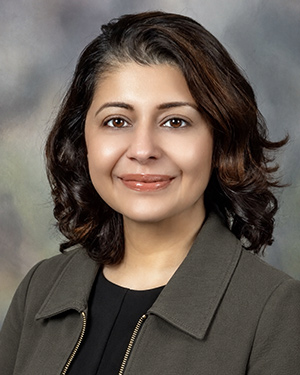
Sadaf Khawar, Ph.D.
Assistant Professor in the Health Service Psychology doctoral and Clinical Psychology,
College of Human Sciences and Humanities
Contact number: 281-283-3377
Email: khawar@uhcl.edu
Office: B1508.14
Biography
Dr. Sadaf Khawar is an Assistant Professor in the Health Service Psychology doctoral
and Clinical Psychology master’s programs at the University of Houston–Clear Lake.
She earned her Ph.D. in Clinical Psychology, with a specialization in Child and Adolescent
Psychology, from Montclair State University and completed her APA-accredited doctoral
internship in the Pediatric Developmental Disabilities track at the Kennedy Krieger
Institute/Johns Hopkins University School of Medicine. She subsequently completed
a postdoctoral fellowship in Autism and Related Conditions in the Masonic Institute
for the Developing Brain, Department of Pediatrics at the University of Minnesota
Medical School. Dr. Khawar is also a Board Certified Behavior Analyst (BCBA).
Dr. Khawar’s program of research lies at the intersection of contextual behavioral
science, developmental psychopathology, and implementation science, with an overarching
focus on improving well-being and quality of life among autistic and neurodivergent
individuals and their families. Her research examines family processes and transdiagnostic
mechanisms—including parenting stress, psychological flexibility, emotion regulation,
social cognition, and executive functioning—that may contribute to mental health and
intervention outcomes across development. A complementary line of her work investigates
how sociocultural and systemic factors, including stigma, culture, immigration experiences,
and barriers to service access, shape the experiences of autistic individuals and
their families, particularly within historically underserved communities including
immigrant and diaspora families in the United States.
A central goal of Dr. Khawar’s research is to bridge research and practice by developing,
adapting, and evaluating accessible, culturally responsive, and neurodiversity-affirming
supports. Her intervention research includes contextual behavioral approaches such
as Acceptance and Commitment Therapy/Training (ACT), caregiver-focused interventions,
social and emotional interventions, and community-based approaches to supporting autistic
and developmentally disabled youth and their families. She is particularly interested
in identifying how, for whom, and under what contexts interventions work and translating
these findings into supports that can be implemented effectively in real-world clinical
and community settings. Her scholarship emphasizes community-engaged and participatory
approaches, including partnering with autistic individuals, caregivers, clinicians,
and community stakeholders in identifying research priorities and developing meaningful
supports.
Clinically, Dr. Khawar has broad expertise in the assessment and treatment of pediatric
psychological, behavioral, and developmental conditions, with a particular specialization
in autism and related neurodevelopmental conditions, including complex and co-occurring
presentations. Her clinical training spans behavioral, cognitive-behavioral, and contextual
behavioral approaches and includes autism diagnostic and neuropsychological assessment,
caregiver coaching and parent training, and evidence-based individual and group interventions.
She is research reliable on the Autism Diagnostic Observation Schedule-2 (ADOS-2)
and Autism Diagnostic Interview-Revised (ADI-R) and is a certified provider of the
UCLA PEERS® intervention.
Dr. Khawar is committed to mentoring the next generation of clinical scientists and
practitioners and to creating pathways into psychological science for students at
multiple stages of training. Her research lab welcomes collaboration with doctoral
and master’s students as well as undergraduate and high school research trainees.
Across research, teaching, clinical training, and service, she aims to advance inclusive
systems of care that center community priorities and promote dignity, belonging, and
quality of life for neurodiverse individuals and families locally and globally.
Areas of Expertise
- Autism and neurodevelopmental conditions
- Developmental psychopathology and transdiagnostic processes
- Family well-being and caregiver mental health
- Contextual behavioral science and Acceptance and Commitment Therapy/Training
- Emotion regulation, psychological flexibility, and social cognition
- Culturally responsive and community-engaged research
- Service access and health disparities
- Intervention development, adaptation, and implementation
- Assessment and differential diagnosis
- Evidence-based and neurodiversity-affirming interventions
Courses (Current Academic Year)
- PSYC 5734: Ethics, Law, Professional Consultation
- PSYC 7736: Ethics and Professional Issues in Health Service Psychology (combined sections)
- PSYC 7339: Assessment Practicum