




Faculty Spotlight: Dr. Jordan Mitchell, College of Business
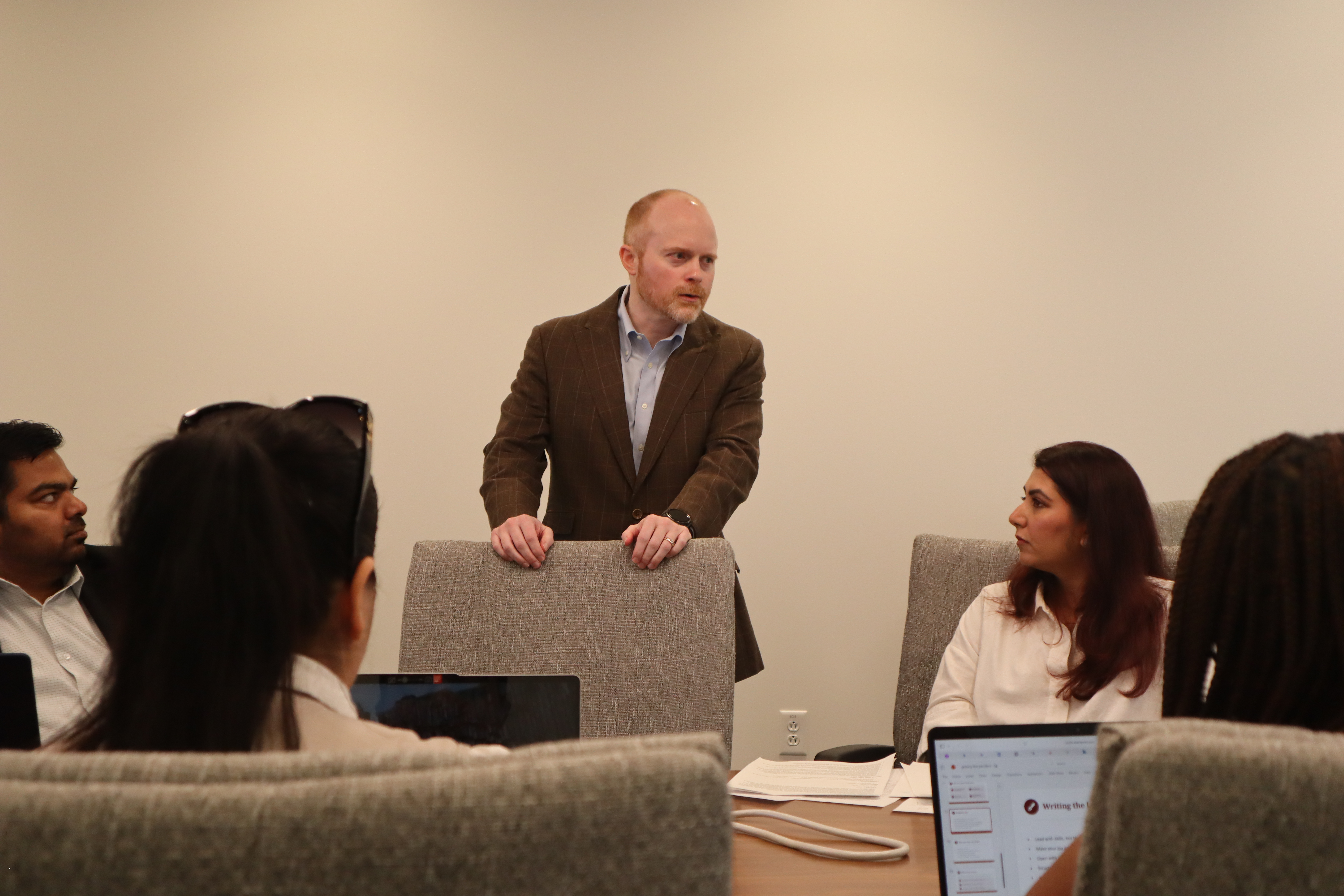
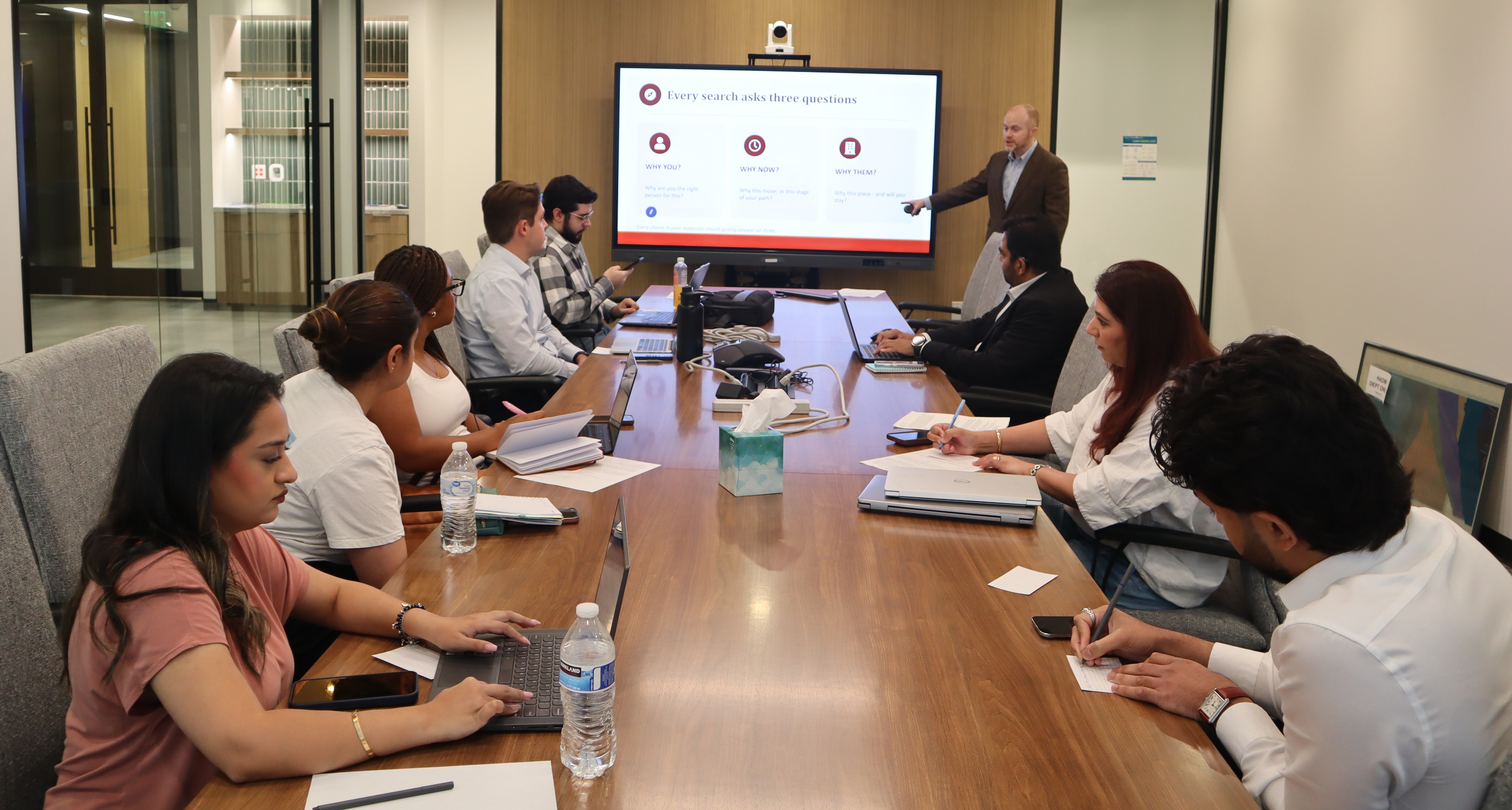
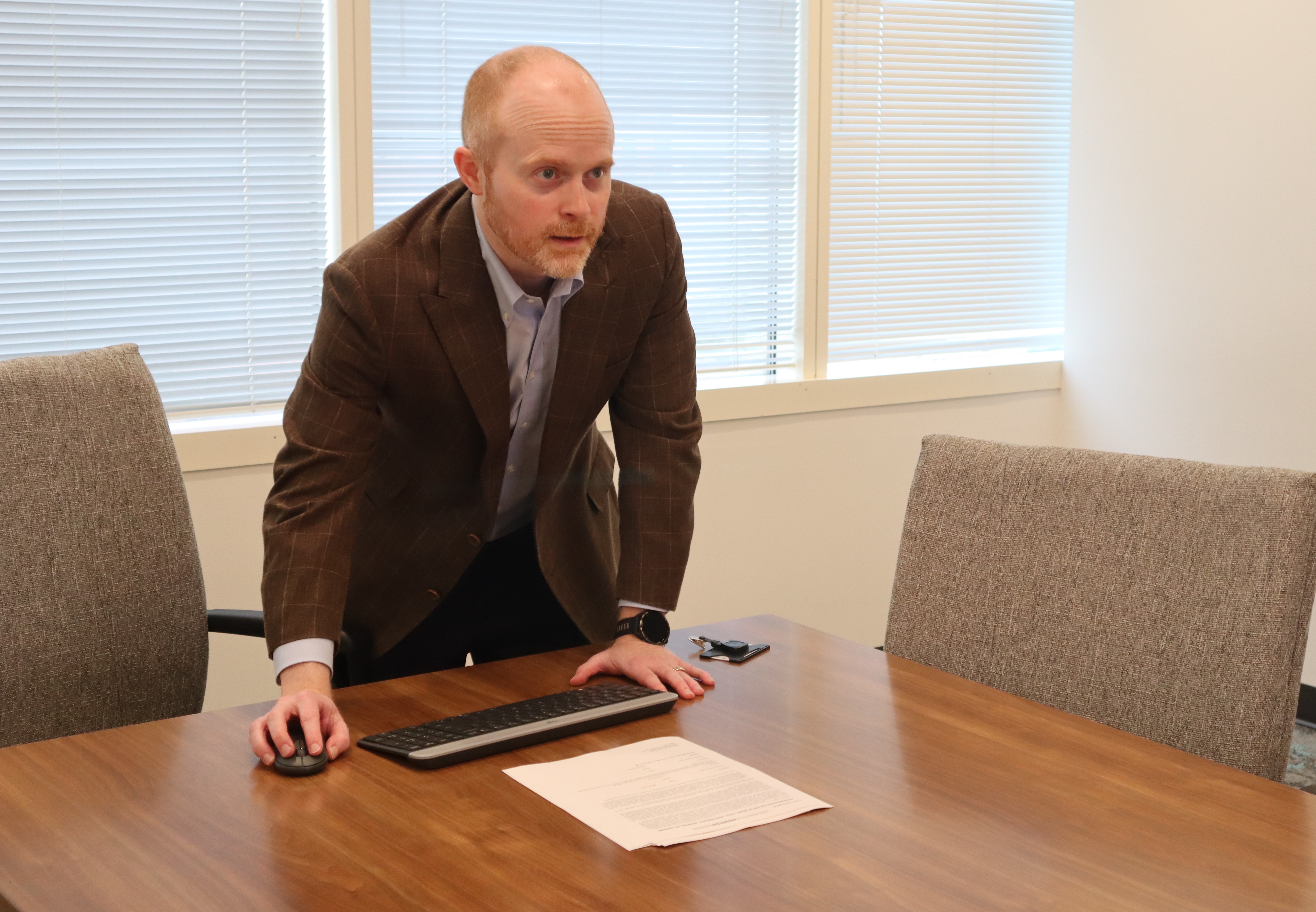
Students file into a conference room at the UHCL Medical Center campus one-by-one until they take up most of the seats around the table. Dr. Jordan Mitchell, department chair and professor of healthcare administration, has prepared a workshop for them about resumes and cover letters.
This is not a class. These students are not required to be here, yet here they are, many during their lunch breaks, taking part in professional development that Dr. Mitchell has created as part of the Healthcare Admin Fellowship Summer Camp, this being the inaugural year. Fifteen to 20 students come on Tuesdays at lunchtime during the summer, working to get a leg-up on the highly competitive fellowships at hospital systems across the nation.
Many of these students have taken classes with Dr. Mitchell, but all of them are benefitting from his commitment to student success in the Master’s of Healthcare Administration and Master’s of Healthcare Administration / Master’s of Business Administration programs at UHCL, which has grown from 119 students when he arrived in Fall 2024 to 179 students for Spring 2026.
“I’m here in this position at this time for a reason,” Dr. Mitchell said. “I mean, I’m originally from North Carolina. All of my family is in North Carolina. I am in Texas for this job, so I’m going to do the best that I can.”
That best can be seen as you look across the conference room while students take notes and participate in what is a voluntary, extracurricular activity. It is just these types of activities that students say have been the difference for them.
“For what he’s doing for the program, it’s a lot of behind the scenes work in terms of setting up the future of this program, growing the program, strengthening its name and its reputation,” said Gabby Mata, recent graduate of the joint Master’s of Healthcare Administration and Business Administration program. “There’s a lot that we don’t see as students. Dr. Mitchell is calculated and very passionate about excelling for his students everything has a purpose.”
The Fellowship Summer Camp is just one of those purposeful moves. Dr. Mitchell also revamped the Capstone class to work as an immersive, problem-based learning exercise, putting students into roles within a hospital system where they have to make decisions based on ever-changing realities.
“A student might wonder, or might even say, this is a quirky way of approaching the class, but ultimately, there’s going to be a use for it later on, and one might not reflect on that until well into their career.”
Skylar Shaw, another recent graduate from the Master’s in Healthcare Administration program, experiences like the Capstone course really bring learning to life.
“Just sitting there at the table in that role-playing activity that we did, I felt like I had put another pin on my jacket,” she said. “I felt like I climbed another level of understanding and comprehension that is hard to get whenever you’re just sitting in a regular class.”
Shaw worked with Dr. Mitchell as a graduate student worker from November 2025 until she graduated in May. Her work and insight helped Dr. Mitchell design programs for students focused on recruitment, retention and placement of students after they graduate.
“A lot of the work that I have done alongside him has been centered on trying to come up with ideas to help students feel like they belong, help them feel seen and supported when it comes to finding a job,” Shaw said.
That level of support and care is evident not only to students in the Healthcare Administration program, but to those who work with Dr. Mitchell. Keegan Kelly, administrative assistant at the UHCL Texas Medical Center campus, works directly with Dr. Mitchell on a daily basis. He was hired in 2025 by Dr. Mitchell.
“He is a great boss,” Kelly said. “He actually cares about people. He cares about their advancement. He cares about his students, and he cares about his job.
“One of the things that he talks about a lot is just his motivation for the job and his motivation to make the department better,” Kelly said. “He’s a genuine guy, and so that’s what’s cool about working here.”
That level of care also extends to the College of Business and UHCL in general. Associate Dean and Associate Professor of Management Dr. Troy Voelker said that Dr. Mitchell’s ability to assess program outcomes and compare them to the real world has not only benefitted Healthcare Administration students, it has benefited all students in the MBA program. When Dr. Mitchell saw that students needed additional skills in Microsoft Excel, he created modules for Healthcare Administration students that ultimately became the course Management 50A1. Now, students comment on the relevance of what they are learning.
 “Students who take the course love the course,” Dr. Voelker said. “In the course feedback
to the instructor, they say, ‘I use what we did at work. This was immediately useful.
I understood what I was doing.’ Jordan really grasps the importance of competency
development, not just content coverage.”
“Students who take the course love the course,” Dr. Voelker said. “In the course feedback
to the instructor, they say, ‘I use what we did at work. This was immediately useful.
I understood what I was doing.’ Jordan really grasps the importance of competency
development, not just content coverage.”
And that has been the focus of revamping the UHCL Master’s of Healthcare Administration program: creating graduates who can soar.
“The way I look at students and teaching is what I call the 10/80/10 rule,” Dr. Mitchell said. “The top 10% of students, they’re going to succeed no matter what you do. There will also be students who struggle, despite your best efforts. The middle 80 is where you can make your impact, so I like to approach teaching like that. How can I move that middle 80-move the needle for that middle 80.
“I was in the middle of the pack, so I get it,” Dr. Mitchell said. “I try to tailor what I do to reach that middle 80 and move them forward.”
Dr. Mitchell doesn't just draw on his own days as a middle-of-the-pack student - he draws on his experiences as a musician with a practical streak.
“In high school, academics didn’t hold my attention, but I was a very good saxophone player,” Dr. Mitchell said.
So, after graduating from high school, he sought one of the best Jazz Studies programs in the nation at East Carolina University. But in the last couple of years of his undergraduate program, the realities of life as a professional musician kicked in. A walk across campus to the ECU business school and he was enrolled in the MBA program after graduation while working at Northwestern Mutual as an administrative assistant. From there, visiting his grandmother in a less than quality nursing home showed him how quality must be introduced into the healthcare system. That led to a PhD in Health Services Policy and Management from University of South Carolina in Columbia.
All of these experiences set Dr. Mitchell up to focus on creating a program that has produced graduates like Vamsee Potluri, executive medical center director and CEO of the Washington DC Veterans Affairs Medical Center, who was recently named the 2026 Robert S. Hudgens Memorial Award Winner for Young Healthcare Executive of the Year.
“The professors like Dr. Mitchell who inspired me, showed me it was possible, they created opportunities,” Potluri said. “They brought in leaders, and they had connections that brought in people like we wanted to be. I never felt like Dr. Mitchell ever said, ‘I don’t have time for you.’ He was always there for us, listening.
“I just appreciate his leadership,” Potluri said. “Great leaders create more great leaders, not just a great resume. He could definitely go run a hospital with his experience and do great things, but he chooses to continue to develop the workforce of tomorrow, so I think that’s extremely noble.”
Developing the workforce is what Dr. Mitchell intends to do in the Capstone class.
“Nobody learns an instrument by listening to someone talk about it,” Dr. Mitchell said. “You learn by playing - you practice, someone challenges you, you get better. That never left me. It's why the capstone class puts students in a hospital boardroom instead of behind a textbook. Jazz taught me that you master the fundamentals so that when the moment changes on you - and in healthcare, it will - you can quickly adapt.”
Dr. Mitchell sees his impact on students and remembers what his grandmother said when he was young about where his path would lead.
“My grandmother used to say, ‘You’re going to be a teacher.’ I’m like, have you heard me talk? But no. She called it. She called it,” he said.
And even though the students in the conference room at the UHCL Medical Center campus aren’t in a class, Dr. Jordan Mitchell is definitely teaching. And the students are definitely listening.