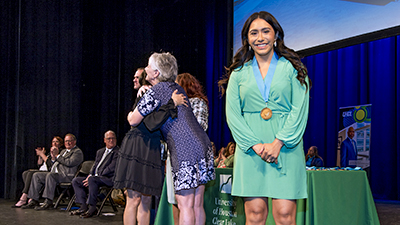

Faculty Spotlight: Dr. Michael LaMontagne, College of Science and Engineering
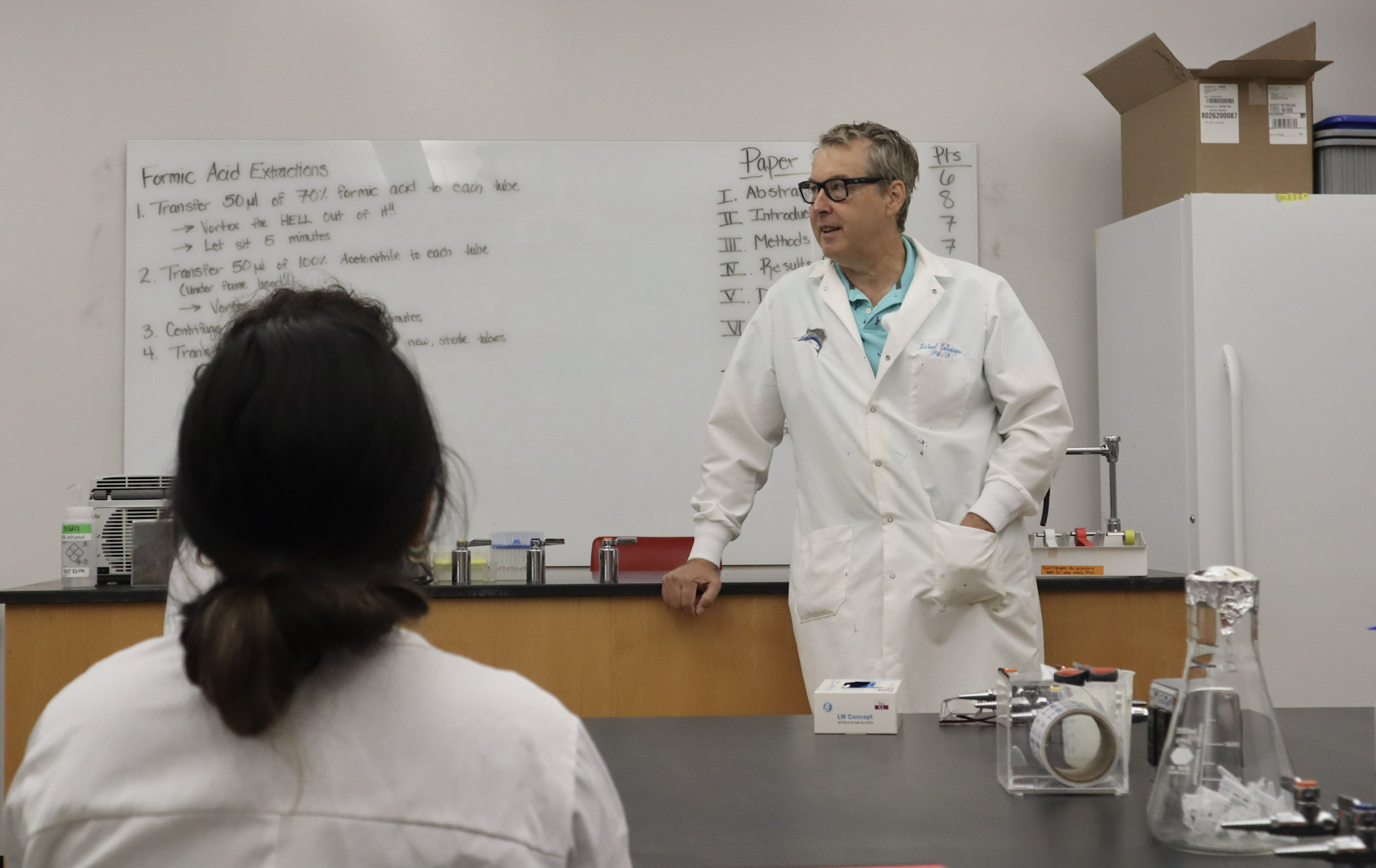
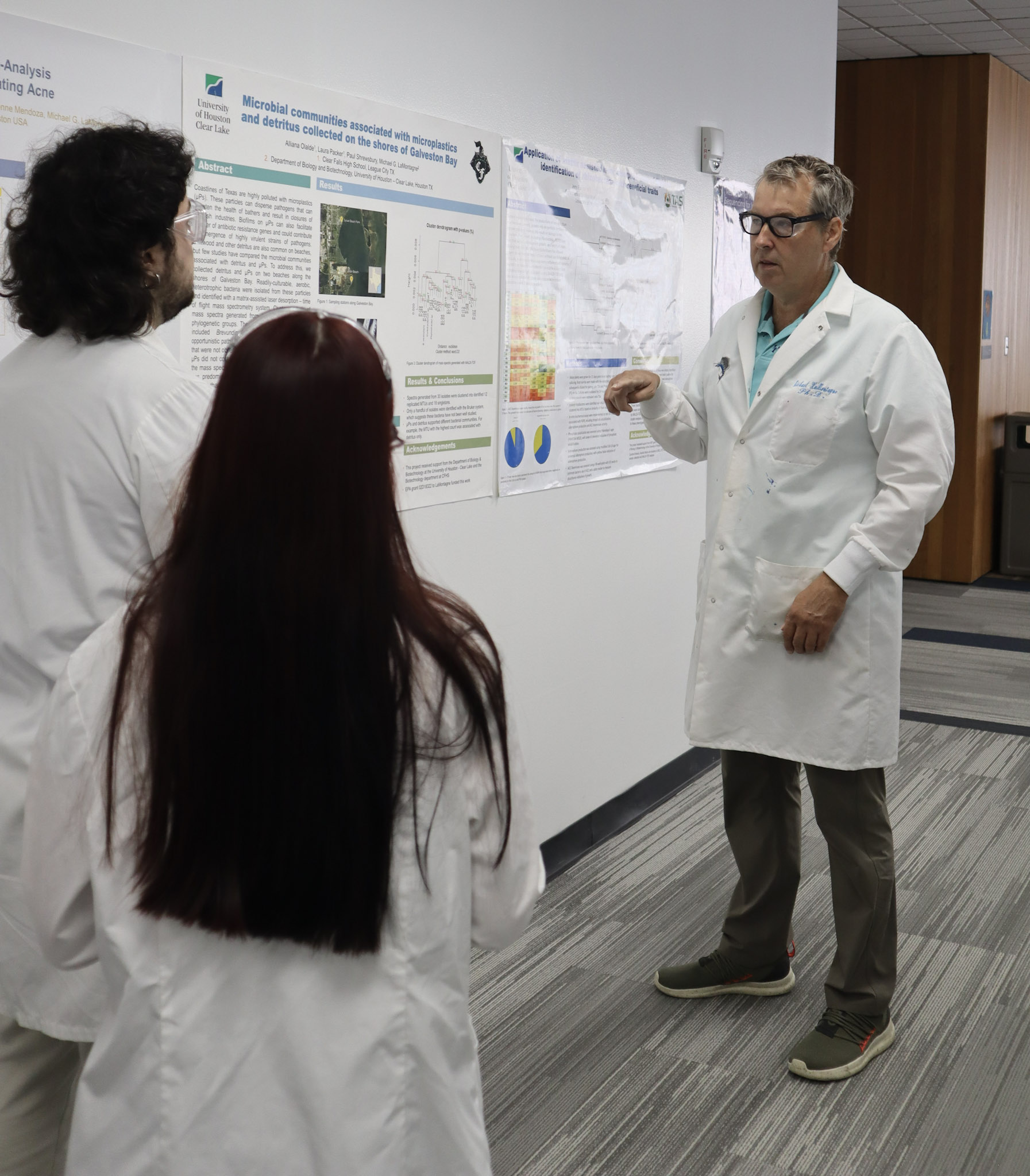
As students enter Dr. Michael LaMontagne’s lab, he reminds them to put on goggles. Decked out in white lab coats, they don their goggles. Instead of mixing chemicals or testing reactions, students start the lab by reviewing the posters all along the halls outside of the lab. These are posters created by students doing experiments in Dr. LaMontagne’s lab, most for the Student Conference for Research and Creative Arts hosted by UHCL.
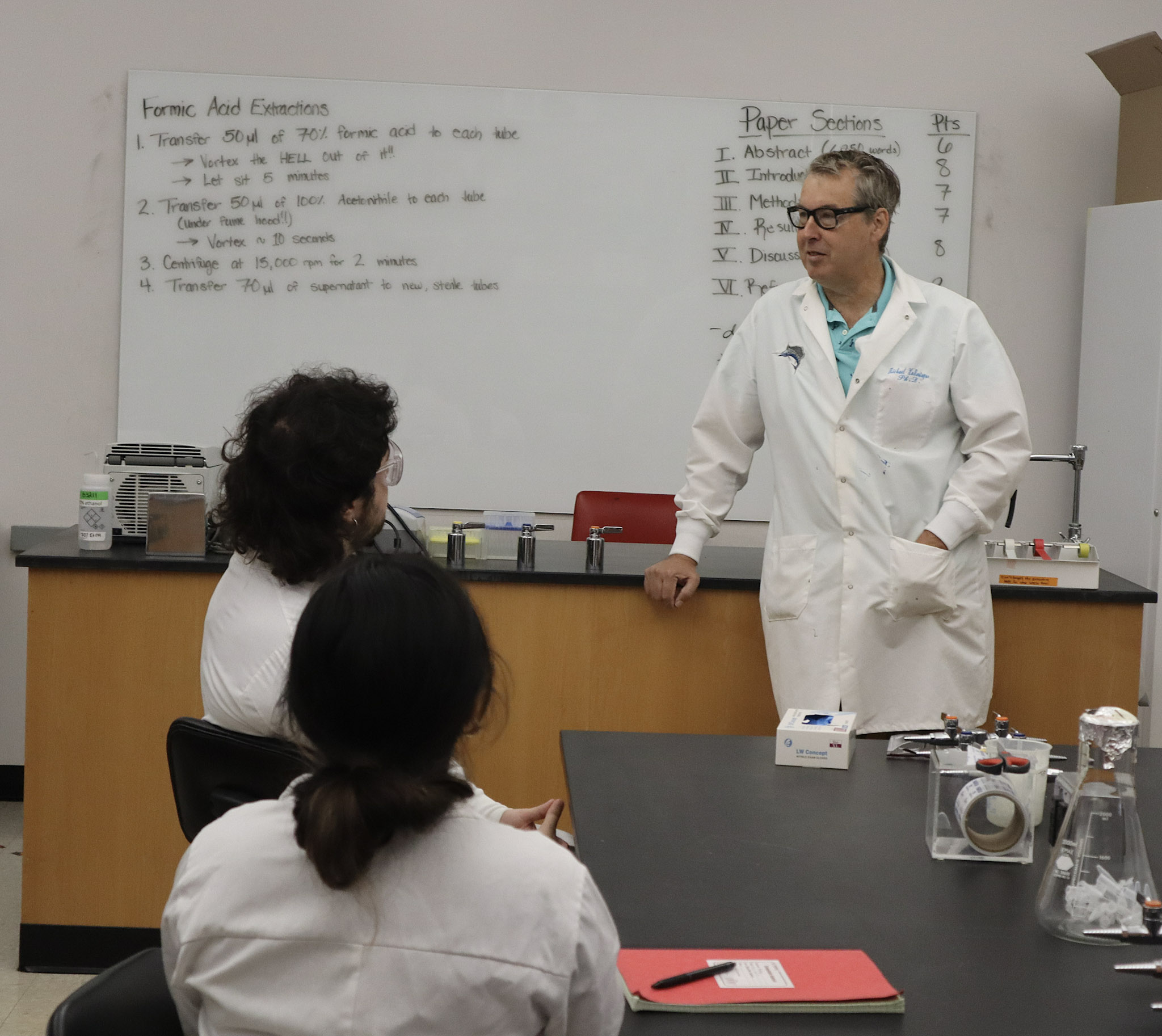
“Michael has a unique approach where he has actually gotten grants from the National Science Foundation to use his sophomore-level Microbiology classes as a way of doing research,” said College of Science and Engineering Dean Dr. Jennifer Irvin. “He has students at the sophomore level doing research funded by a federal grant that he can then turn around and publish. As sophomores, these students are getting a great opportunity to be able to get involved in research at a very significant level and can turn around and have a product that they can show when they graduate or when they apply to medical schools.”
In Spring 2026, that approach yielded eight poster presentations at the UHCL Student Research Conference, two publications in peer-reviewed journals and three presentations at other conferences. The approach has also yielded $1.4 million dollars in funding from the National Science Foundation, EPA, NASA and Pathways to STEM programs. This support, along with a multi-institutional grant from the NIH provides students in sophomore microbiology classes and beyond with the tools they need to do authentic research that matters.
“He's doing some very impactful research,” Dr. Irvin said. “He has a couple of patents granted, so he's thinking outside of the box, trying to find ways to develop intellectual property that can be shared with the rest of the world and then protected for the benefit of the university.”
Much of this high-level research, whether it’s studying bacterial growth in clean rooms at Johnson Space Center or the aftereffects of Hurricane Harvey in Galveston Bay is conducted with his colleague Dr. Michael Allen, at the University of North Texas Health Science Center, and every student he teaches. This provides all student in the program with life-changing opportunities. Tetyana King was one of those students.
A Ukrainian immigrant, King was a student of Dr. LaMontagne’s. Now, she works at NASA.
“I know him from his course of Microbiology, but I never thought about microbiology,” King said.
King never thought about bioinformatics either, but when Dr. LaMontagne mentioned the field as a new frontier, King believed him, joined his lab and began analyzing data.
“I didn’t know that I’m able to analyze data,” King said. “I thought that computer science and all this stuff is not for me. It’s like, I don’t have such a brain. It’s for really, really smart guys, and he destroyed this stereotype.
“When I started to work with data, I said: ‘Oh my gosh! It’s so interesting. I can understand,” King said. “I applied for a master’s degree in bioinformatics [biotech with a specialization in bioinformatics], and I graduated. I continue to do research in the field. I’m also really happy that he was able to secure funding for a MALDI-TOF mass spectrometer. Because of that, many students have had the chance to learn this technology and build careers in the field. Working with mass spectra was where my own journey began. It was my first real step into bioinformatics and computational biology. Learning how to analyze data completely changed the way I see science and the world around me. It opened up a much bigger and more fascinating world than I ever imagined.”
Interesting, unique and influential are words that faculty, students and funding agencies use to describe Dr. LaMontagne’s approach to working with students in a beginning Microbiology class to create impactful research.
“He is a visionary,” King said. “He does what he believes that will be for the students’ benefit, and if you accept that, you will open up a lot. When I joined his lab, I thought it’s just training or coursework, but he said: ‘No, no, no, not at all. You’re going to do real research. Just try it.’ And then step-by-step, I became a scientist.”
Dr. LaMontagne said that is the purpose of the program he has created at the University of Houston Clear Lake, to expose students to cutting-edge technology and give them the skills they need for industry. When he arrived in 2016, he looked around and began to build.
“I turned my focus to bring in the curriculum for training microbiology to reflect skills that I know are needed in industry,” Dr. LaMontagne said. “The microbiology skills taught in most schools hadn’t changed much since the 19th Century; no one knew about bioinformatics or metagenomic analysis, which have become prevalent throughout the medical field as well. So, I’ve been developing a program that trains students in skills that I used in industry, and will provide students more opportunities.”
These are the skills that Dr. LaMontagne has found helpful in his career moving across the country, studying everything from estuaries to agriculture. These are the skills that federal agencies like NASA, the NSF and the EPA have valued, providing funding for equipment and supplies to support Dr. LaMontagne’s lab and microbiology classrooms at UHCL.
“We’ve been able to build, through that support, a program that has the equipment for students to do research that is relevant to today’s biotech field and research,” he said.
Proximity to the Johnson Space Center has meant Dr. LaMontagne has been able to do research in an area he enjoys—kitesurfing and windsurfing on the water he studies.
“It perplexes me profoundly that there aren’t more people windsurfing and kitesurfing,” he said. “I want to be out on the water. My goal is to leave the bounds here and get up in the air.”
And leaving the bounds of what most people consider safe is what he has built in the Microbiology program, doing research with students while focusing on the fundamentals, like following a standard operating procedure.
“If you ask my students, they would say I value doing it by the book,” Dr. LaMontagne said. “That focus on fundamentals means students in his teaching labs are doing research that they can present to an external audience.”
“I am very proud that our students have done both the science, but importantly they demonstrated that they have the teamwork skills that are required to get a project done in a few weeks,” he said.
Dr. Lory Santiago-Vázquez, associate professor of biology and biotechnology, works with Dr. LaMontagne on several grants. She has known him since the two were students at Woods Hole, and she understands Dr. LaMontagne’s perspective.
“I think in his perfect world, he will be a professor that teaches research,” Dr. Santiago-Vázquez said. “His heart is in the actual research. I think that’s what he enjoys. That’s why he enjoys guiding students through research projects. He incorporates it in one way or another in all of his courses.”
That focus continues to produce results for Dr. LaMontagne, his students and UHCL. For a visual representation of the results, visit his office and look at the whiteboard filled with projects currently in process.
“If you’re looking at that board, these are just student projects that are going on this semester,” he said, “graduates and undergraduates. It’s not the whole list, but I’m continuously amazed how students can come in and pick up something and do it.
“And the data that we generate as a class is very, very impressive,” he said. “It impresses the scientific community. Some would say that this is not a good fit for a regional university; that our students may not have the skills, time or background to do this sort of thing, nor do we have the resources. Clearly, we do. They do.”
And that’s what anyone can see when they visit the hallway outside of Dr. LaMontagne’s lab—proof that UHCL undergraduate students and their professor are active researchers.