


Visualization and Guided Imagery
Guided imagery and visualization are techniques used to help you imagine yourself being in a particular state.
Recordings are designed to help you visualize yourself relaxing or engaging in positive changes or actions. These exercises can help you reduce anxiety, improve self-confidence, or cope more effectively with difficult situations. The video (mp4) recordings are located in Counseling and Mental Health Center YouTube channel.
Mindfulness, Relaxation and Guided Imagery
Guided Imagery is a technique used to induce relaxation and decrease stress and anxiety. The recordings below allow you to visualize yourself in a peaceful scene. As you become absorbed in the scene you will deepen your state of relaxation.
Audio Only
Brief Mindfulness
A brief introduction to mindful awareness. Audio only, 7:11 minutes.
Brief Mindfulness Transcript© Matthew Boone, LCSW
Begin by sitting comfortably with your feet flat on the ground and your back supported by the back of the chair. Arrange your head, neck, and shoulders so that they are upright but not stiff. As we do this exercise, you can do one of two things with your eyes: you can either close them or, if you prefer not to, you can leave them open with your lids half closed and your eyes directed at a point approximately 30° in front of you. This is how we will conduct most mindfulness exercises this semester. This is not the "right" way to do it, but it's a useful way to start.
If you are comfortable, begin by allowing your eyes to close gently. In your minds eye, turn your attention to your breathing…*Simply observe the rising and falling of your breath in your chest and belly… Though you will likely be tempted, there is no need to try to control your breathing in any way. As best you can, allow your breath to breathe itself… Next, turn your attention to your body in the chair… Scan your body, observing the places where you make contact with the chair… Notice the sensations of touch or pressure there…
As you do this exercise, you will notice that your mind tends to drift off. That's
completely normal: that is what minds do. Minds are prone to drifting off toward problem
solving, predicting, worrying, planning, judging, and a variety of other activities.
When you notice that you have done this, just gently bring yourself back to this moment
and the area of your body or the environment to which I'm directing your attention…
Now, turn your attention to your feet inside your shoes… Notice the variety of sensations there: touch, pressure, temperature… See if you can pick out each individual toe… If it helps, wiggle your toes a little bit… Next, turn your attention to the places where your skin makes contact with the air – on your face, on your hands, wherever… Notice the sensations there… Next, turn your attention to the sounds around you… Both inside this room and, if you can pick them out, outside this room… Finally bring your attention back to your breathing… Watch the rising and falling in your chest and belly as your breath flows in and flows out… This here, what you are noticing, is the present moment and this exercise is a simple practice in mindfulness: paying attention to the here and now, without judgment.
*To maintain a pace that is not too fast (a common problem), consider allowing yourself to complete three full breaths with each ellipsis.
Leaves on a Stream Mindfulness
A brief mindfulness exercise with leaves on a stream imagery. Audio only, 11:22.
Leaves on a Stream Mindfulness Transcript© Matthew Boone, LCSW
The purpose of the exercise is to notice when there’s a shift from looking at your thoughts to looking from your thoughts.
Some people find visualization very hard. So it’s a good idea at the start of any exercise requiring imagination to say, “Different people imagine in different ways. Some see very vivid pictures as on a TV screen. Other people imagine with words, sounds, feelings, or ideas. However you imagine is absolutely fine.”
Leaves on a Stream
- Find a comfortable position, and either close your eyes or fix your eyes on a spot, whichever you prefer.
- Imagine you’re sitting by the side of a gently flowing stream, and there are leaves flowing past on the surface of the stream. Imagine it however you like— it’s your imagination. (Pause 10 seconds.)
- Now, for the next few minutes, take every thought that pops into your head, place it on a leaf, and let it float on by. Do this regardless of whether the thoughts are positive or negative, pleasurable or painful. Even if they’re the most wonderful thoughts, place them on the leaf and let them float on by. (Pause 10 seconds.)
- If your thoughts stop, just watch the stream. Sooner or later your thoughts will start up again. (Pause 20 seconds.)
- Allow the stream to flow at its own rate. Don’t speed it up. You’re not trying to wash the leaves away— you’re allowing them to come and go in their own good time. (Pause 20 seconds.)
- If your mind says, This is stupid or I can’t do it, place those thoughts on a leaf. (Pause 20 seconds.)
- IIf a leaf gets stuck, let it hang around. Don’t force it to float away. (Pause 20 seconds.)
- If a difficult feeling arises, such as boredom or impatience, simply acknowledge it.
Say to yourself, “Here’s a feeling of boredom” or “Here’s a feeling of impatience.”
Then place those words on a leaf, and
let the leaf float on by. - From time to time, your thoughts will hook you, and you’ll lose track of the exercise.
This is normal and natural, and it will keep happening. As soon as you realize it’s
happened, gently acknowledge it and
then start the exercise again.
After #9, continue for several minutes or so, periodically punctuating the silence
with this reminder:
“Again and again, your thoughts will hook you. This is normal. As soon as you realize
it, start the exercise again from the beginning.”
You can end the exercise with a simple instruction such as this:
“And now, bring the exercise to an end … and sit up in your chair …. and open your
eyes. Look around the room … and notice what you can see and hear … and take a stretch.
Welcome back!”
Afterward debrief the exercise with the client:
What sort of thoughts hooked her? What was it like to let thoughts come and go without
holding on?
Was it hard to let go of any thoughts in particular?
(Clients often want to hold on to positive thoughts, but that defeats the purpose
of the exercise; the aim is to learn how to let thoughts come and go.)
What feelings showed up? Was acknowledging the feeling (as in instruction 8) useful?
(This is an acceptance technique.)
Did she speed up the stream, trying to wash the thoughts away? If so, she’s probably
turning it into a control technique, trying to get rid of thoughts. This is not the
aim. The aim is to observe the natural “flow of thoughts,” allowing them to come and
go in their own good time. That’s why I’ve put
instruction 5 in there.
Practical Tip: Some people find visualization very hard. I’m one of them. So it’s
a good idea at the start of any exercise requiring imagination to say, “Different
people imagine in different ways. Some see very vivid pictures as on a TV screen.
Other people imagine with words, sounds, feelings, or ideas. However
you imagine is absolutely fine.”
Progressive Muscle Relaxation
Ease the tension in your mind and body. Audio only, 7:04 minutes.
Progressive Muscle Relaxation Transcript
Progressive muscle relaxation is an exercise that relaxes your mind and body by progressively tensing and relaxation muscle groups throughout your entire body. You will tense each muscle group vigorously, but without straining, and then suddenly release the tension and feel the muscle relax. You will tense each muscle for about 5 seconds. If you have any pain or discomfort at any of the targeted muscle groups feel free to omit that step. Throughout this exercise you may visualize the muscles tensing and a wave of relaxation flowing over them as you release that tension. It is important that you keep breathing throughout the exercise. Now let’s begin.
Begin by finding a comfortable position either sitting or lying down in a location where you will not be interrupted.
Allow your attention to focus only on your body. If you begin to notice your mind wandering, bring it back to the muscle you are working on.
Take a deep breath through your abdomen, hold for a few second, and exhale slowly. Again, as you breathe notice your stomach rising and your lungs filling with air.
As you exhale, imagine the tension in your body being released and flowing out of your body. And again inhale…..and exhale. Feel your body already relaxing.
As you go through each step, remember to keep breathing .
Now let’s begin. Tighten the muscles in your forehead by raising your eyebrows as high as you can. Hold for about five seconds. And abruptly release feeling that tension fall away.
Pause for about 10 seconds.
Now smile widely, feeling your mouth and cheeks tense. Hold for about 5 seconds, and release, appreciating the softness in your face.
Pause for about 10 seconds.
Next, tighten your eye muscles by squinting your eyelids tightly shut. Hold for about 5 seconds, and release.
Pause for about 10 seconds.
Gently pull your head back as if to look at the ceiling. Hold for about 5 seconds, and release, feeling the tension melting away.
Pause for about 10 seconds.
Now feel the weight of your relaxed head and neck sink. Breath in…and out.
In…and out.
Let go of all the stress In…and out.
Now, tightly, but without straining, clench your fists and hold this position until I say stop. Hold for about 5 seconds, and release.
Pause for about 10 seconds.
Now, flex your biceps. Feel that buildup of tension. You may even visualize that muscle tightening. Hold for about 5 seconds, and release, enjoying that feeling of limpness.
Breath in...and out.
Now tighten your triceps by extending your arms out and locking your elbows. Hold for about 5 seconds, and release.
Pause for about 10 seconds.
Now lift your shoulders up as if they could touch your ears. Hold for about 5 seconds, and quickly release, feeling their heaviness.
Pause for about 10 seconds.
Tense your upper back by pulling your shoulders back trying to make your shoulder blades touch. Hold for about 5 seconds, and release.
Pause for about 10 seconds.
Tighten your chest by taking a deep breath in, hold for about 5 seconds, and exhale, blowing out all the tension.
Now tighten the muscles in your stomach by sucking in. Hold for about 5 seconds, and release. Pause for about 10 seconds.
Gently arch your lower back. Hold for about 5 seconds, relax. Pause for about 10 seconds.
Feel the limpness in your upper body letting go of the tension and stress, hold for about 5 seconds, and relax.
Tighten your buttocks. Hold for about 5 seconds…, release, imagine your hips falling loose. Pause for about 10 seconds.
Tighten your thighs by pressing your knees together, as if you were holding a penny between them. Hold for about 5 seconds…and release.
Pause for about 10 seconds.
Now flex your feet, pulling your toes towards you and feeling the tension in your calves. Hold for about 5 seconds, and relax, feel the weight of your legs sinking down.
Pause for about 10 seconds.
Curl your toes under tensing your feet. Hold for about 5 seconds, release. Pause for about 10 seconds.
Now imagine a wave of relaxation slowly spreading through your body beginning at your head and going all the way down to your feet.
Feel the weight of your relaxed body. Breathe in…and out…in…out….in…out.
Adapted from The Anxiety & Phobia Workbook, by Edmund J. Bourne
Abdominal Breathing
Relax your mind and body by learning to breathe more deeply. Audio only, 4:38 minutes.
Abdominal Breathing Transcript
This exercise will demonstrate a style of breathing called Abdominal Breathing. Abdominal breathing is a technique that will allow you to breathe more deeply.
When you become stressed or anxious, you tend to take rapid, shallow breaths high in your chest. When this happens, you are over-breathing, exhaling more carbon dioxide and inhaling less oxygen. This can cause you to hyperventilate, making you feel dizzy and can even make you feel anxious. When you are relaxed you breathe more fully and more deeply from your diaphragm.
When we are under stress, our sympathetic nervous system, the system in the body that
energizes and mobilizes us when faced with stress, is activated. When our sympathetic
nervous system is activated, our muscles tense, our breathing becomes more rapid,
and our heart rate increases. Under chronic
stress, the sympathetic nervous system becomes over stimulated and unbalanced.
By learning abdominal breathing, you can stabilize your sympathetic nervous system and activate your parasympathetic nervous system, which is the area of the body that facilitates rest and relaxation.
Learning to breathe correctly is important because breathing is both a source of energy and a source of relaxation.
This exercise will help you learn to breathe deeply through your abdomen, rather than shallowly through your chest. This will result in feelings of relaxation because it is difficult to feel tense and breathe deeply at the same time.
Choose a comfortable position, sitting or lying down, where you will not be interrupted.
Place one hand on your abdomen and one on your chest.
Take a deep breath in through your nose, and try to fill the bottom of your lungs. Send the air as low into your abdomen as you can, hold for a few seconds, and exhale slowly, pushing out all the air.
Again….breath in (hold for a few seconds)…..and exhale
Pause for about 5 seconds
As you breathe in, you should notice your hand on your abdomen rising higher than your hand on your chest. This is a sign that you are breathing using your diaphragm.
Breathe in, imagine you are slowly breathing in all of the air around you (Hold for a few seconds) andexhale, slowly blowing out all the tension and stress. Make sure you don’t hike your shoulders up. Keep them down and relaxed.
As you exhale feel your abdomen contracting as you are blowing out all the air. Keep your breathing smooth and regular, never gulping or exhaling suddenly.
Now repeat this 8 more times
Breathe in (pause for about 5 seconds)…..and out
Wait about five seconds
Now, notice how your body feels. Your muscles have loosened, your heart rate has slowed,
and you are entering a state of relaxation.
You may repeat this exercise for up to five full minutes as much as twice per day. Practicing abdominal breathing on a regular basis can significantly reduce feelings of stress and anxiety or can be used during the beginning stages of panic to prevent panic attacks.
Adapted from The Anxiety & Phobia Workbook, by Edmund J. Bourne
Managing Math Anxiety
Visualize studying for math successfully. Audio only, 10:02 minutes.
Managing Math Anxiety Transcript
[Adapted from materials from Conquering Math Anxiety by Cynthia Arem, Union County College Academic Learning Centers, Mission College Math Learning Center, and Inner Health Studio]
Many people experience anxiety associated with studying math. This guided imagery will help you relax and visualize the process of working with math effectively and successfully. Visualizing success can promote increased confidence. Relaxation can help you manage the anxiety so that you can do the best you can while working with math.
Begin by becoming very relaxed. Make yourself comfortable in a setting free of distractions for the next few minutes. Find a naturally relaxed sitting position and open posture, your hands resting in your lap or at your sides, your legs uncrossed, and your head balanced in a neutral position.
Start to relax your body. Take a deep breath in through your nose…hold it gently...and let it out through your mouth….
Breathe in again...pause...and exhale fully…. Breathe in…pause... and out.…
In... Out….
In…. Out…
Keep breathing naturally. With each breath out, you become more and more relaxed.
If any anxious thoughts linger, leave them where they are for the moment. You can tend to them later. [Pause.]
Pick a spot in the room for your eyes to comfortably focus on. Hold the focus briefly, and then let that focus go soft. If you choose, you can let your eyes close anytime you like.
Notice some areas in your body where tension tends to linger: your shoulders, jaws, neck, back, chest, stomach, and hands.
Focus first on your shoulders. See how your shoulders relax as your attention is focused on them. Feel the muscles as they loosen and your shoulders as they ease off....
Allow your jaws to relax. Let your lower jaw drop slightly, allowing a slight space between your upper and lower teeth. Feel the muscles of your face become smooth, loose, and relaxed.
Turn your attention to your neck. See how you can let the tension go as you relax the muscles of your neck. Let the relaxation flow down the length of your spine, relaxing all the muscles along the way. Feel the relaxation in your neck and back.
As you become aware of the rhythm of your breathing, let the tension in your chest dissipate with each breath and feel your stomach muscles smooth themselves out and the calm settle in.
Now focus on your hands. Open and close your hands a few times…wiggle your fingers… and then relax. Let your hands be limp and loose.
Scan your body now for any other areas that might be tense. For each area, imagine directing your breath to that area. Imagine breathing in relaxation... and breathing out tension. Breathing in a feeling
of relaxation, and exhaling all the tension. Feel your muscles more relaxed with each breath. Continue to scan your body, relaxing each area.
[Pause.]
Now you are feeling calm and relaxed. Your whole body feels heavy, and you feel grounded, centered, and peaceful.
[Pause.]
Begin to visualize now the process of working with math successfully as you keep these thoughts in mind:
I am an intelligent, talented person.
I can eliminate all distracting and disturbing thoughts. I have confidence in myself.
I see myself accomplishing my goals.
Math is just one of the things I do on the way to accomplishing my goals.
Many capable people get anxious about math. I am not alone.
I have learned to be anxious about math over time. I can also learn to feel okay about math.
Mathematicians work hard to make doing math look easy. I am willing to work hard to master my math material.
It’s natural to want to avoid studying for math as I start to get anxious. I can dial down that anxiety and keep some of it to drive my work.
I will continue to read the math material even if I don’t understand all of it yet.
Sometimes I don’t understand the teacher’s or the textbook’s explanation. But I am resourceful; I can find another source to help me understand.
Like many things, there is often more than one right way to do math. And I don’t have to do math perfectly every time.
I want to understand math thoroughly rather than trying to memorize everything.
I can learn through picturing the material. I will learn enough to put things in my own words
I find that I already know something about math. I can remember something I learned before that is related to the new material. I find connections between new concepts and things I already know.
As long as I take my time, I will understand what every word and symbol means.
I enjoy learning by doing.
I know solving problems is important; I don’t have to wait till I understand everything before I start trying to solve problems.
Homework is not the enemy but an opportunity to work on a new concept and master it. Math used to be mysterious to me. I can take the mystery out of math.
Math is learning a new language, one concept at a time. I will take the time to work many problems for each new concept until I feel a sense of accomplishment.
I’ll practice just as I practice to drive a car or play a musical instrument.
I get frustrated. But I have worked through other frustrating things. I am persistent. I can stick with this. Mistakes are good for me to learn different ways of doing things. They provide materials for me to learn. I don’t have to do math perfectly.
I can be competent in math on the way to achieving my big goals in life. Competency comes through patience, steadfastness, and diligence. I will take the time needed to achieve it.
I am bright and resourceful and can learn anything I choose to.
I am an intelligent and capable person. I’ve succeeded in a lot of things in my life; I can succeed in math, too.
I see myself succeeding in math.
I now say to myself, over and over, these positive affirmations and visualization are true for me.
Body Image
Visualize yourself accepting and appreciating your inner and outer beauty. Audio only, 9:54 minutes.
Body Image Transcript
Guided Imagery & Mindfulness Exercise: Body Image
The purpose of this mindfulness exercise is to provide you with a scene that completely
absorbs your attention and distracts you away from your negative thoughts. As you
become absorbed in the scene you will deepen your state of relaxation and will notice
physical changes.
For body image concerns, this technique can be used to help you think about and attend
to your body in a different way. You will work towards accepting your body and yourself
as a whole.
This process begins by becoming mindful of your own inner experiences in the here
and now.
Negative body image is produced and maintained in your mind. What do you notice about
how you think about your body? What affect does this have on you emotionally? How
do your negative self-statements affect your self-esteem? This exercise will help
you release those negative thoughts and
begin to feel appreciative of your body and accepting of yourself.
Begin by finding a comfortable position either sitting or lying down in a location where you will not be interrupted.
Closing your eyes, allow your attention to focus only on your body. If you begin to notice your mind wandering, bring it back to your body.
Take a deep breath through your abdomen, hold it for a few seconds, and exhale slowly.
Again… in…and out
As you breathe, notice your stomach rising and your lungs filling with air.
As you exhale, imagine the tension in your body being released and flowing away.
Inhale…and exhale.
Feel your body already relaxing.
Now, as you continue breathing, tune into your body. Notice how your body feels. How does it feel where it touches your clothing? Feel the pressure of your body resting on the surface on which you are lying or sitting.
Mindfully scan your body from top to bottom.
Breathe in…and out.
How does it feel? What do you see? Which areas of your body stand out more or less?
Now, think about your body image. What is body image to you?
Take some time to consider your own thoughts and ideas about your body. What are you thinking? What do you see?
Breathe in…and out
As you think about your body, notice how you are feeling. Are you feeling comfortable, satisfied, dissatisfied, disgusted, frustrated? Whatever you are feeling, it’s ok, let yourself feel.
Now tune in to the part of your body you dislike most. Spend some time thinking about that area of your body. What are you thinking? Now how do you feel? How do these thoughts make you feel? Notice how damaging these thoughts can be to your emotions.
Now imagine yourself accepting your body as it is. Imagine feelings satisfied with your physical self.
What might it be like to feel comfortable with your body?
You begin to see yourself as a whole, rather than a collection of parts. You appreciate your own beauty.
Breathe in…and out
You appreciate all the wonderful things your body does for you. How it rejuvenates you when you need energy, how it relaxes you when you need rest.
You feel ok about who you are.
Now repeat after me.
I accept my imperfections. They don’t define me or take away from who I am as a person.
I accept this body I am in. There is no need to be perfect.
I am free of judgment. I will no longer say negative things to myself.
I accept myself.
I am ok.
Breathe in…and out
You take a moment now to relax.
Breathe in…and out
You notice yourself feeling more calm, more satisfied.
You feel yourself beginning towards a path of self-acceptance.
You know that soon you will begin to appreciate yourself.
Breathe in…and and out
When you are ready…slowly begin to turn your attention back to your
environment.
You continue to feel satisfied and relaxed.
Slowly open your eyes and stretch your body, notice how rejuvenated you feel.
Once you have returned to your usual level of alertness, resume your day, continuing to feel relaxed and satisfied.
Adapted from http://www.innerhealthstudio.com & The Body Image Workbook: An Eight Step Program for Learning to Like Your Looks, by Thomas F. Cash
Mindful Movement Meditations on UHCL Campus
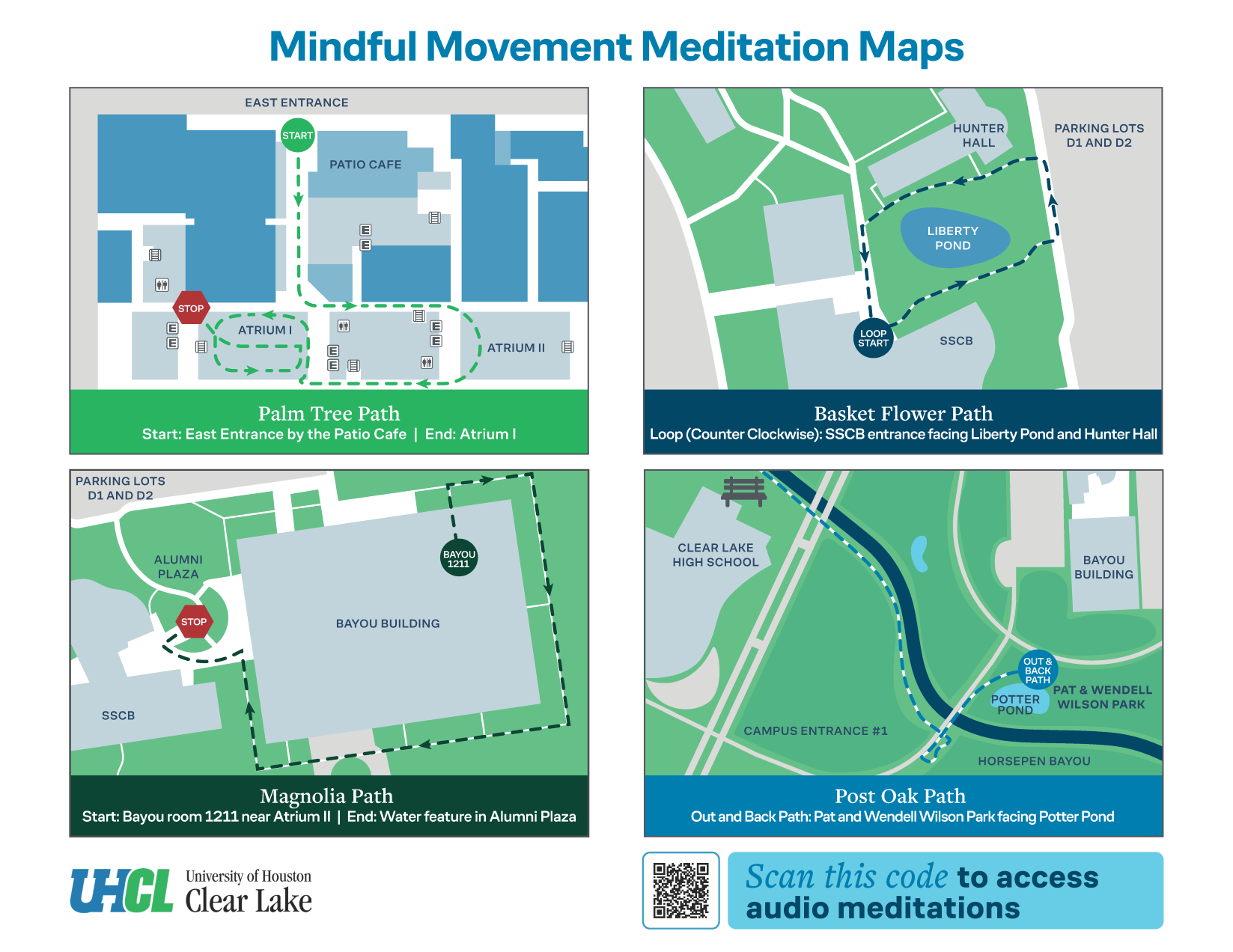
Mindful movement meditations aim to help you become more mindfully connected to the present through your senses. Mindfulness can help you to relax, reduce stress or anxiety, and gain perspective. Nature is a wonderful tool to help us connect to the present, particularly because nature often engages many senses.
Each walking meditation will begin with grounding yourself through feeling your feet on the ground and taking a few steps slowly, noticing the sensations along your feet as well as throughout your body as you mindfully move. Then, the meditation will draw your attention to various senses that you may be experiencing. At any time, come back to noticing sensations of your feet on the ground. Please adjust if walking is not the way that you move your body (in a chair or otherwise).
Introduction to Mindful Movement Meditations
Listen before beginning other meditations
Palm Tree Path
Start: East Entrance by the Patio Cafe | End: Atrium 1 (indoor path through the Bayou
Building)
~ 10 minutes to complete
Basket Flower Path
Loop (Counter Clockwise): SSCB entrance facing Liberty Pond and Hunter Hall (path
around the pond)
~ 5 minutes to complete
Magnolia Path
Start: Bayou room 1211 near Atrium II | End: Water feature in Alumni Plaza (outside/around
the Bayou Building)
~ 10-15 minutes to complete
Post Oak Path
Out and Back Path: Pat and Wendell Wilson Park facing Potter Pond (path along Horsepen
Bayou)
~ 30 minutes to complete
Audio and Video Guided Imagery
Beach Visualization
Imagine relaxing on a beautiful beach.
Initially, you hear audio with a black screen for about 40 seconds. Then, images display with the audio.
8:57 minutes
Beach Visualization Transcript
The purpose of this visualization scenario is to provide you with a scene that completely absorbs your attention and distracts you away from your anxious thoughts. As you become absorbed in the scene you will deepen your state of relaxation and will notice physiological changes. Your muscles will become less tense, your heart rate will slow, and your breathing will deepen. In this scene, you will imagine yourself relaxing on a peaceful beach.
Begin by finding a comfortable position either sitting or lying down in a location where you will not be interrupted.
Take a deep breath through your abdomen, hold for a few seconds, and exhale slowly. As you breathe, notice your stomach rising and your lungs filling with air.
Breathe in…and out
As you exhale, imagine the tension in your body being released and flowing away. Inhale… exhale. Feel your body already relaxing.
As you go through each step, remember to keep breathing. Inhale…exhale
Feel your body releasing all the tension, becoming relaxed, calm, peaceful. Feel the weight of your body, the limpness of your arms and legs. A wave of relaxation is flowing from your head, down to your neck, chest, back, arms, legs, and feet.
Now imagine yourself walking towards a quiet, inviting beach. You notice the white sand stretching along the shoreline as far as you can see.
You begin to feel the warmth of the sun across your face. You stand there a moment and just take in the warmth, you feel it flowing all through your body.
Breathe in…and out
As you walk in the sand, you feel its warmth on your feet, while at the same time feeling the coolness of the ocean breeze on your skin.
You gaze at the ocean and see a deep shade of blue with white crests of waves sweeping towards the shore. You take a moment to watch the beauty of the ocean.
You hear the calm breaking of the waves. The waves are washing up onto the sand and receding back towards the ocean…washing up…and flowing back…washing up…and flowing back. You listen to the calming rhythm of the waves.
You take a deep breath in and can smell the cleanness of the salty air…and exhale. You allow yourself to appreciate the soothing scent of ocean air.
You begin to walk slowly towards the water. As you step closer to the ocean, you can feel the firmness of the wet sand. The cool, soft ocean water sweeps across your feet, relieving you from the heat of the sun. With every touch of water to your skin, you feel more and more relaxed.
Breathe in…and out
You begin to leisurely walk along the shoreline. As you walk, you notice a soft beach chair resting lightly in the sand. You lay in the beach chair, taking a deep breath, and enjoy the warmth of the sun, the coolness of the breeze, and the pleasant sound of the waves.
You lay there a moment and allow yourself to sink into the comfortable chair, feeling more and more relaxed.
You feel totally relaxed. All of your tension has melted away. Breathe in…and out
Pause for a few seconds Breathe in…and out Pause for a few seconds
When you are ready to return from your vacation, do so slowly. Gently bring your attention back to the room, still feeling relaxed and comfortable. As you bring yourself back to a level of alertness, keep that relaxation in your mind and body. Open your eyes, stretch, and feel refreshed.
You can practice this visualization exercise whenever you need to take a mental vacation. Visualization is a skill so the more you practice it, the more effective the scene will be.
Forest Visualization
Visualize walking about in a wonderful forest.
Initially, you hear audio with a black screen for about 1:35 minutes. Then, images display with the audio.
4:25 minutes
Forest Visualization Transcript
The purpose of this visualization scenario is to provide you with a scene that completely absorbs your attention and distracts you away from your anxious thoughts. As you become absorbed in the scene you will deepen your state of relaxation and will notice changes in your body. Your muscles will become less tense, your heart rate will slow, and your breathing will deepen. In this scene, you will imagine yourself in a forest.
Begin by finding a comfortable position either sitting or lying down in a location where you will not be interrupted.
Take a deep breath through your abdomen, hold it for a few seconds, and exhale slowly. As you breathe, notice your stomach rising and your lungs filling with air.
Breathe in…and out
As you exhale, imagine the tension in your body releasing and flowing away. Inhale… and exhale. Feel your body already relaxing.
As you go through each step, remember to keep breathing. Inhale…exhale
You are becoming relaxed, calm, peaceful. Feel the weight of your body, the limpness of your arms and legs.
A wave of relaxation is flowing from your head, down to your neck, chest, back, arms, legs, and feet. Breathe in…and out
Now imagine yourself walking into a beautiful forest.
You are surrounded by tall, elegant trees colored many shades of green and brown. When you look up, you see the tops of the trees swaying softly in the wind. Rays of sun are peaking through the leaves, illuminating the forest with natural light.
The tree tops blend together, creating a protective shelter above you, shading you from the hot sun.
As you stand, and take in the beauty of the forest, you begin to appreciate the serenity of the scene. Breathe in…and out
The ground, covered in leaves and soil, feels soft beneath your feet. The air is clean and crisp. The breeze is cool and comfortable.
You begin to feel relaxed and calm. A sense of peace flows over your entire body. You take a deep relaxing breath in and notice the freshness of the clean air.
Breathe In…and out
You stop to listen to the soothing sounds of the forest. You hear the sounds of the leaves moving gently in the wind. You can hear birds quietly chirping in the far distance. You hear water slowly flowing down a small creek nearby.
You stop to appreciate the soothing sounds of the forest and you let yourself feel completely peaceful.
Breathe in…and out
Just ahead you see a large smooth rock. You decide to lie down on the rock and begin to notice how comfortable it is. All of your tension has melted away. You feel calm and relaxed.
Breathe in…and out
When you are ready, slowly begin to turn your attention back to your environment, notice the sounds of the room. You continue to feel peaceful and calm.
Slowly open your eyes and stretch your body, notice how rejuvenated you feel.
Once you have returned to your usual level of alertness, resume your day, continuing to feel relaxed.
Wildlife Sanctuary Visualization
Imagine wandering through a peaceful wildlife sanctuary.
Initially, you hear audio with a black screen for about 30 seconds. Then, images display with the audio.
5:44 minutes
Wildlife Sanctuary Visualization Transcript
The purpose of this visualization scenario is to provide you with a scene that completely absorbs your attention and distracts you away from your anxious thoughts. As you become absorbed in the scene you will deepen your state of relaxation and will notice changes in your body. Your muscles will become less tense, your heart rate will slow, and your breathing will deepen. In this scene, you will imagine yourself in a wildlife sanctuary.
Begin by finding a comfortable position either sitting or lying down in a location where you will not be interrupted.
Take a deep breath through your abdomen, hold for a few seconds, and exhale slowly. As you breathe, notice your stomach rising and your lungs filling with air.
Breathe in…and out
As you exhale, imagine the tension in your body being released and flowing away. Inhale… exhale. Feel your body already relaxing.
As you go through each step, remember to keep breathing. Inhale……exhale
Feel your body releasing all the tension, becoming relaxed, calm, peaceful. Feel the weight of your body, the limpness of your arms and legs.
A wave of relaxation is flowing from your head, down to your neck, chest, back, arms, legs, and feet. Breathe in…and out
Now imagine yourself walking through a preserved area of wilderness, surrounded by nature. You are walking along a soft dirt path with green grass, tall trees, and vibrant flowers all around.
There are no cell phones, no televisions, no sounds of rushing traffic. You only hear the soft sounds of birds chirping, wind gently blowing, trees rustling.
The sanctuary is calm and peaceful.
As you walk slowly down the path, you begin to appreciate the serenity of this scene.
It is a beautiful, sunny day. You can feel the warmth of the sun and the soft cool breeze relaxing your body . You reach over to feel the silkiness of a freshly bloomed flower and you inhale to take in its sweet scent.
Breathe In…and out
As you breathe, you take in the freshness of the clean air. You notice two squirrels, happily roaming through the trees.
As you continue to walk, you notice a small pond with three white ducks swimming elegantly across the pond, barely disturbing the stillness of the water.
As you watch, you stop to enjoy the serenity of wildlife and the peacefulness of nature. You begin to notice the beauty of the birds, some blue, some red, and some gray. Overhead you notice more birds soaring gracefully above the trees.
Breathe in…and out
You appreciate the purity of the scene. Breathe in…and out
You feel content, relaxed, peaceful.
When you are ready, slowly begin to turn your attention back to your environment, notice the sounds of the room. You continue to feel peaceful and calm. Slowly open your eyes and stretch your body, notice how rejuvenated you feel.
Once you have returned to your usual level of alertness, resume your day, continuing to feel relaxed.
Candle Visualization
Experience the serenity of a room filled with candles.
Initially, you hear audio with a black screen for about 18 seconds. Then, images display with the audio.
4:33 minutes
Candle Visualization Transcript
The purpose of this visualization scenario is to provide you with a scene that completely absorbs your attention and distracts you away from your anxious thoughts. As you become absorbed in the scene you will deepen your state of relaxation and will notice changes in your body. Your muscles will become less tense, your heart rate will slow, and your breathing will deepen. In this scene, you will imagine being in a room of candles.
Begin by finding a comfortable position either sitting or lying down in a location where you will not be interrupted.
Take a deep breath in through your abdomen, hold for a few seconds, and exhale slowly. As you breathe, notice your stomach rising and your lungs filling with air.
Breathe in…and out
As you exhale, imagine the tension in your body being released and flowing away. Inhale… exhale. Feel your body already relaxing.
As you go through each step, remember to keep breathing. Inhale…exhale
You are becoming relaxed, calm, peaceful. Feel the weight of your body, the limpness of your arms and legs.
A wave of relaxation is flowing from your head, down to your neck, chest, back, arms, legs, and feet. Breathe in…and out
Now imagine yourself walking into a small room, filled with candles.
The room is illuminated only by candlelight. In the center of the room is a plush pallet of blankets and pillows. You lie down on the blankets, allowing your body to sink into the softness beneath you.
You begin to feel your tension leaving. A sense of peace flows over your entire body. Breathe in…and out
As you lie peacefully in the room, you watch the flickering of the candlelight. You see the soft halo of light around the flame. As you watch, you notice the scene relaxing you even more.
Breathe in…and out
You begin to take a closer look at the candle, noticing its color, its shape, and its scent. You see the colors of the flame.
You breathe in and take in your favorite aroma. You feel safe, warm, and calm.
You begin to appreciate the tranquility of the room. Breathe in…and out
Imagine the candles melting away all the tension in your body. You feel totally relaxed.
When you are ready, slowly begin to turn your attention back to your environment, notice the sounds of the room. You continue to feel peaceful and calm.
Slowly open your eyes and stretch your body, notice how rejuvenated you feel.
Once you have returned to your usual level of alertness, resume your day, continuing to feel relaxed.
White Cloud Visualization
Visualizing relaxing, while floating on a soft, white cloud.
Initially, you hear audio with a black screen for about 18 seconds. Then, images display with the audio.
8:26 minutes
White Cloud Visualization Transcript
The purpose of the visualization scenario is to provide you with a scene that completely absorbs your attention and distracts you away from your anxious thoughts. As you become absorbed in the scene you will deepen your state of relaxation and will notice changes in your body. Your muscles will become less tense, your heart rate will slow, and your breathing will deepen. In this scene, you will imagine yourself floating on a cloud.
Begin by finding a comfortable position either sitting or lying down in a location where you will not be interrupted.
Take a deep breath through your abdomen, hold it for a few seconds, and exhale slowly. As you breathe, notice your stomach rising and your lungs filling with air.
Breathe in…and out
As you exhale, imagine the tension in your body being released and flowing away. Inhale... exhale. Feel your body already relaxing.
As you go through each step, remember to keep breathing. Inhale…exhale
Feel your body releasing all the tension, becoming relaxed, calm, peaceful. Feel the weight of your body and the limpness of your arms and legs.
A wave of relaxation is flowing from your head, down to your neck, chest, back, arms, legs, and feet. Breathe in…and out
Now imagine yourself floating on a soft fluffy white cloud. The cloud is lifting you from where you are sitting and is holding you in the air. You begin to feel lighter as you sink into the softness of the cloud.
You lie there a moment and begin to notice how comfortable you are becoming. As your body relaxes into the cloud your tension melts away.
Breathe in…and out.
As you float into the clear blue sky, you feel the warmth of the sun and the coolness of the breeze, making the perfect temperature.
Notice where your body is touching the cloud, how soft it feels, like you are floating on air The cloud is swaying gently in the air, like a boat on smooth water.
As you float through the sky, you feel safe, relaxed, calm.
You begin to let yourself rest in the soft support of the cloud. As you look around, you notice other clouds in the sky, illuminated by the sun as they float gently passed you. You take a moment to enjoy this beautiful sight.
As you float higher and higher you breathe in the clean fresh air. Breathe in…and out
You feel totally relaxed. You notice how peaceful the sky is, how calm it is, quiet.
Now, when you are ready, allow your cloud to begin its slow quiet decent back to earth. As you get closer and closer to the ground you begin to smell the sweet scent of blooming flowers. You continue to feel calm and relaxed.
The cloud gently places you on the soft surface of the grass below. You begin to slowly and gently bring your attention back to the room, still feeling relaxed and comfortable.
As you bring yourself back to a level of alertness, keep that relaxation in your mind and body. Open your eyes, stretch, and feel refreshed
Peaceful Meadow Visualization
Experience the calmness of a peaceful meadow.
Initially, you hear audio with a black screen for about 36 seconds. Then, images display with the audio.
5:51 minutes
Peaceful Meadow Visualization Transcript
The purpose of this visualization scenario is to provide you with a scene that completely absorbs your attention and distracts you away from your anxious thoughts. As you become absorbed in the scene you will deepen your state of relaxation and will notice changes in your body. Your muscles will become less tense, your heart rate will slow, and your breathing will deepen. In this scene, you will imagine being in a beautiful meadow.
Begin by finding a comfortable position either sitting or lying down in a location where you will not be interrupted.
Take a deep breath through your abdomen, hold for a few seconds, and exhale slowly. As you breathe, notice your stomach rising and your lungs filling with air.
Breathe in…and out
As you exhale, imagine the tension in your body being released and flowing away. Inhale… exhale. Feel your body already relaxing.
As you go through each step, remember to keep breathing. Inhale…exhale
Feel your body releasing all the tension, becoming relaxed, calm, peaceful. Feel the weight of your body, the limpness of your arms and legs. A wave of relaxation is flowing from your head, down to your neck, chest, back, arms, legs, and feet.
Breathe in…and out
Now imagine yourself walking into a large, beautiful meadow, surrounded only by nature.
You see rolling hills of green with small white and lavender flowers scattered across the grass. You notice the flowers swaying elegantly with the wind. Far into the distance, you see the blue shadows of tall mountains. Overhead, there are birds flying gracefully across the blue sky.
You begin to appreciate the serenity of the scene. Breathe in…and out
It is a clear sunny day. You can feel the warmth of the sun and the coolness of the gentle breeze relaxing your body. Walking further into the meadow you notice the softness of the grass beneath your feet.
As you take in the beauty of the scene, you begin to feel relaxed and calm. A sense of peace flows over your entire body. You take a deep relaxing breath in and notice the freshness of the clean air.
In…and out
As you inhale, you smell the sweet fragrance of the flowers around you.
You feel safe, warm, and relaxed. You decide to lie down in the soft grass. You feel the weight of your body sinking into the comfort of the ground beneath you. All of your tension melts away.
You close your eyes and listen to the soft sounds of the wind. You can hear the gentle movement of the trees and the quiet chirping of birds far in the distance.
You let yourself feel completely peaceful. Breathe in…and out
When you are ready, slowly begin to turn your attention back to your environment, notice the sounds of the room.
You continue to feel peaceful and calm.
Slowly open your eyes and stretch your body, notice how rejuvenated you feel. Once you have returned to your usual level of alertness, resume your day, continuing to feel relaxed.
Mindful Meditation Resources
Click on the links below to access a variety of free mindful meditations.
- UCLA Health MARC Guided Meditations
- UC San Diego Center for Mindfulness Guided Audio and Video
- Dr. Kristin Neff Self-Compassion Guided Practices and Exercises
- Dartmouth Student Wellness Center Mindfulness Exercises
- The Free Mindfulness Project Free Resources
- HelpGuide.org Explore Meditation
- McGill University Student Wellness Hub Audio Meditation
- VA Veterans Health Library Mindfulness & Relaxation Resources
Helpful Links
Helpful Books
- The Anxiety and Phobia Workbook, 4th Ed., by Edmund J. Bourne
- The Body Image Workbook:
An Eight Step Program for Learning to Like you Looks, by Thomas Cash - The Mindfulness and Acceptance Workbook for Anxiety:
A Guide to Breaking Free from Anxiety, Phobias and Worry Using Acceptance and Commitment Therapy, by John Forsyth and Georg Eifert - The Mindfulness and Acceptance Workbook for Depression:
Using Acceptance and Commitment Therapy to Move Through Depression and Create a Life Worth Living, by Kirk Strosahl and Patricia Robinson - Performance Resource Press
- Conquering Math Anxiety by Cynthia Arem
Contact
-
Counseling and Mental Health Center
Phone: 281-283-2580
Fax: 281-226-7241
www.uhcl.edu/cmhc
SSCB 3103
2700 Bay Area Blvd, Box 331
Houston, TX 77058-1002
View CMHC Location on Map (PDF)
Regular office hours:
Mon: 9 a.m. - 5 p.m.
Tue-Fri: 8 a.m. - 5 p.m.
Please call ahead during holidays and semester breaks.
